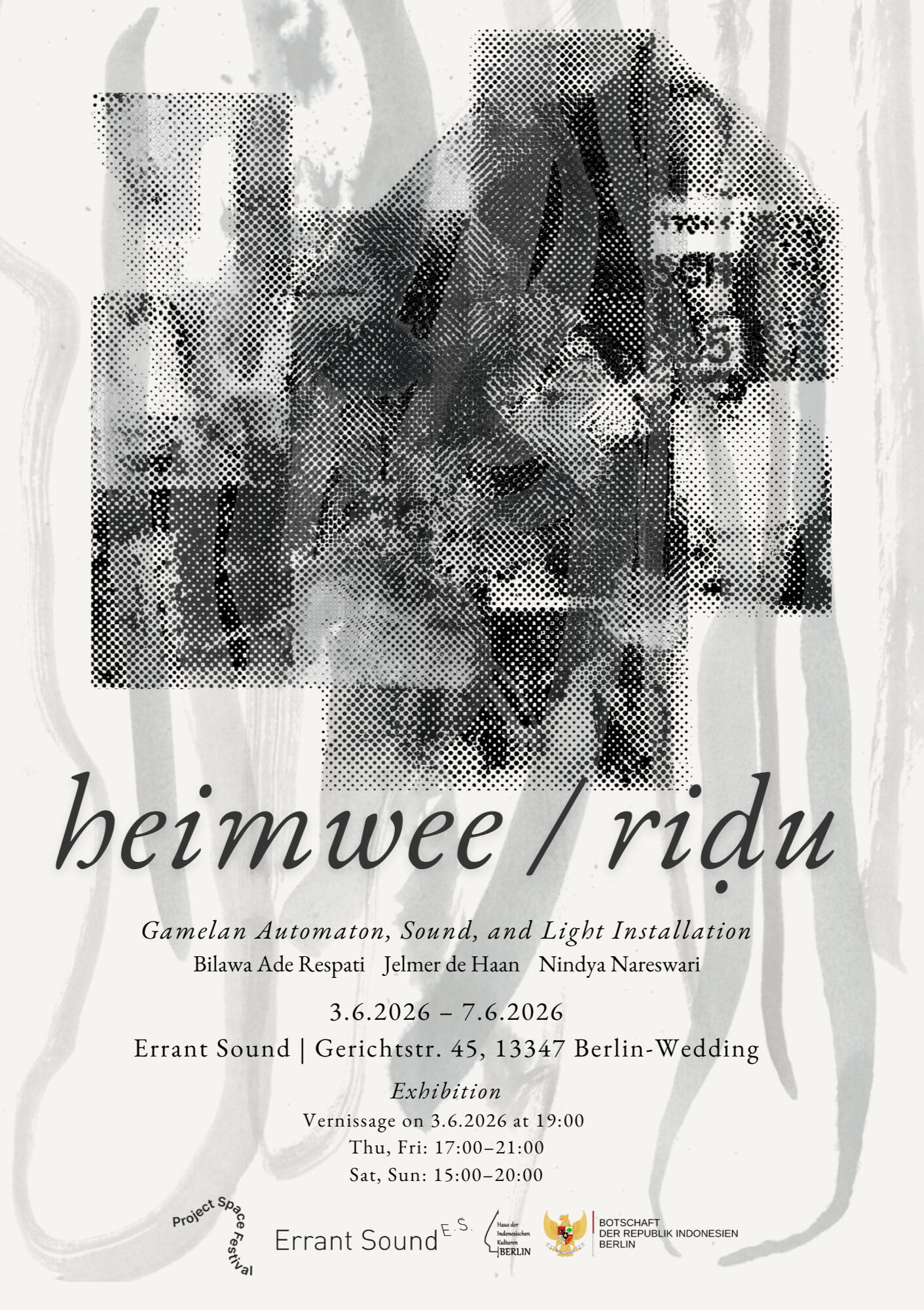
Heimwee / Riḍu
Gamelan Automaton, Sound and Light Installation
About the Installation
“Heimwee / Riḍu” is a multimedia installation for gamelan automaton, surround sound and light by composers Jelmer de Haan and Bilawa Ade Respati, and lighting designer Nindya Nareswari. The work is inspired by a historical narrative at the end of Dutch colonial rule during the Japanese occupation of Indonesia (1942–1945). The installation tells a story about “longing for a home that does not exist (anymore).” Indonesian poets and modernists long for an imagined independent homeland; the Dutch placed in internment camps faced hardships that are contrasted with their colonial life.Given the colonial relationship between the Netherlands and Indonesia in the past, history is written differently by each nation. Memories were selected, events were interpreted: which version of history can we agree upon? By whom is that agreement made? Can we deny the genuine longing for a home that everyone feels? How does this reflect on our current world situation? The audience is invited to experience the stories through a combination of multichannel soundscapes, self-playing gamelan and a light installation.The work is made possible with the kind support of Errant Sound, Haus der Indonesischen Kulturen in Berlin, and the Project Space Festival Berlin. We are grateful for the artistic and technical advice from Emese Csornai and Adrian Latupeirissa.
Exhibition
3.6.2026–7.6.2026
Errant Sounds | Gerichtstrasse 45, 13347 Berlin-WeddingVernissage 3.6.2026
19:00–22:00Opening time
Thu, Fri: 16:00–20:00
Sat, Sun: 15:00–20:00Part of the Project Space Festival Berlin
Credits
Sound composition: Bilawa Ade Respati, Jelmer de Haan
Light installation: Nindya NareswariCurated and hosted by Steffi Weismann and Nico Daleman at Errant Sound.Gamelan automaton was built by Adrian Benigno Latupeirissa in collaboration with Emese Csornai for the installation Distant Memories of the Void, funded by the Initiative Neue Musik.
About the Dutch-East-Indies
Jelmer de Haan
The country now known as the Republic of Indonesia was once a colony of the Kingdom of the Netherlands. Beginning as part of the spice, sugar and coffee trade from the early 17th century, by the 20th century this had shifted to the export of oil, rubber and rare minerals. The territory was vast, 1,919,440 km², and encompassed hundreds of native peoples, from small tribes to big Kingdoms, each with their own language, culture, religion and ethnicity.In the 19th and 20th centuries, there was a big increase of Dutch migrants in the Dutch-East-Indies. Many men took indigenous wives and concubines, and entire Dutch families followed, giving birth to new generations. The short-lived society that emerged was characterised by deep racial divisions: a European upper layer including Indo-Dutch people; below that a small local middle layer including a Chinese-Indonesian minority; and below that the vast majority of farmers and labourers forming an underclass bordering on slavery and serfdom. In the larger cities and on Java, an awareness of a distinct national identity grew among the indigenous and Indo-Dutch population, and with it the call for self-governance, led among others by Sukarno and Mohammad Hatta.When Germany occupied the Netherlands on 10 May 1940, the Dutch East Indies was left to govern itself. It had its own army, the KNIL (Royal Dutch East Indies Army). This changed on 9 March 1942, when Japan occupied the territory after 3 months of fighting.By the end of the 19th century, Japan was the only Asian country that had successfully transformed itself into a modern technological state. It remained independent while most other Asian countries had come under European or American influence, and it had defeated Russia in war. After the Second Sino-Japanese War, Japan shifted its attention to Southeast Asia, promoting the idea of a self-sufficient Asian bloc of nations, free from Western interference and under Japanese leadership.The news of liberation from Dutch governance was initially received with great enthusiasm by Indonesians. They welcomed the Japanese army with flags and slogans such as "Japan is our older brother" and "Banzai Dai Nippon!" ("Long live Great Japan!"). This view was quickly revised. Political policy shifted as the war progressed, but broadly speaking the Japanese occupying forces regarded Indonesia and its inhabitants as resources to the Japanese war effort. There was the practice of torture, sex work enforcement, political arrests and harsh punishments including executions. During the occupation, the popularity of the Indonesian independence movement grew considerably.Dutch civilians, other Europeans and Indo-Dutch people were a primary target of the Japanese and were interned in camps. Around 42,000 prisoners of war, primarily KNIL soldiers, were held in POW camps. Around 100,000 civilians were held in civilian internment camps. The civilian camps were divided into women's camps, holding women, children and the elderly, and men's camps, which included boys from the age of 10 onward.Although there were no food shortages in the Dutch East Indies as a whole, there was a severe shortage of food, water, medicine and healthcare within the camps. Infectious diseases, partly caused by poor sanitation, spread freely and cost thousands their lives. The camps were run under a strict regime. Violations were punished with beatings or hours of standing in the sun without water. Roll call was held daily, often for long periods in burning heat, to count the prisoners and honour the Japanese emperor. Former prisoners described the camps as concentration camps, or even passive extermination camps: through the large-scale and systematic withholding of food and medicine, inmates died gradually over time.In total, between two and four millions of Indonesians died during the Japanese occupation, mostly as the result of famine, but also by murder, torture and forced labour. In the internment camps, 20% of the prisoners of war and 16% of the civilians died.1When Japan surrendered in August 1945, following the atomic bombings of Hiroshima and Nagasaki and the Soviet declaration of war against Japan, Sukarno proclaimed the independence of the Republic of Indonesia. This marked the beginning of a bloody independence war with the Netherlands, which lasted until 1949.It took months after Japan's surrender for Allied forces to reach the internment camps. While the newly proclaimed Republic of Indonesia struggled to stabilise the situation, a wave of violence broke out against the former colonial population. During this period known as the ‘Bersiap’, former Western prisoners remained in the camps, now under the protection of Japanese soldiers, until they could evacuate to the Netherlands from the end of 1945-1946.***‘Heimat’, homeland, is a phenomenon that is difficult to define. Yet the longing for it is felt by all of us and takes many different forms.The Japanese occupation permanently transformed the sense of home for the Dutch and other Western inhabitants of the Dutch-East-Indies. Interned in camps, they faced violence from guards, hunger and disease, a world away from their former colonial lives. They longed not only for basic necessities, but for the ease of ordinary daily life. They secretly wrote music and sang songs. They imagined the Allies arriving to free them, and that everything would return to the way it once was.When liberation finally came, it was very different from their expectation. The Bersiap period is often described by camp survivors as the hardest part. When they finally arrived back in the Netherlands, often without any belongings, they could not count on much sympathy from their countrymen. They were told not to complain, since they had a shorter war period and had spent it in a warm country.
End Note
[1]: https://www.niod.nl/en/frequently-asked-questions/japanese-occupation-and-pacific-war-numbers
Takdir / Fate
Bilawa Ade Respati
When the Japanese occupation government was established in 1942, it was clear life would change drastically for Takdir. Who would have thought he would end up in a jail? In 1945, he was detained. A group of young revolutionists asked him to write a guide for their fight for an independent Indonesia. Takdir wrote this guide from a social-cultural perspective, on how to achieve a sovereign, democratic state. When one of the revolutionists was caught, the Japanese secret police found Takdir’s name. Facing with the prospect of death, Takdir found his dignity in the consolation of philosophical inquiry. Nothing could be more noble, he thought in the end, than a death accompanied by one's truest conviction.He thought of a home safe from the worry of the world at the outskirt of Jakarta for his family, where they live off self harvested goods, teaching the children without school system. And for his homeland? He dreamed a land with a culture of the future, of freedom and humanness, of the advancement of science and the prosperity it brings; a culture that born out of a mind that resonates to this imagined future. This mind needs a language to speak its thoughts and to express its feelings: a language of and for the future. Takdir decided to write on the prison wall with his nails.1***Japanese occupation brought with it a cultural policy which was anti-Western. The former Dutch East Indies—soon to be Indonesia—was purged, to "return to its Asian root". The usage of Dutch language was forbidden, but the population was not ready to use the Japanese language. For practicality, the "young" Indonesian language was used instead. It has been used for centuries as a lingua franca in the market, used by many trading nations in the archipelago.But the language, mostly used in a spoken and informal way, posed problems. It didn't have grammatical standard, and has not enough words for the vocabulary of the administrative, medical, the scientific and the industrial world. At the same time, this is the language chosen by the modernist poets. Separating their usage of the language also in the poetic form of their choice, these poets labelled themselves the New Poets (Pujangga Baru)—which was also the name of the magazine wherein they publish their literary work and thoughts between 1933–1942.Parallel to the question of language is the question of its culture. What would an Indonesian culture be? Takdir’s answer to those questions was published in 1935. It triggered an uproar at that time: Indonesian culture must be “different from the pre-Indonesian” one. The pre-Indonesian culture comes from the time of pre-Indonesia, and therefore, built upon a societal and historical situation which was different from the reality of a contemporary and modern Indonesia. Takdir wrote a poem that summarizes his position in the imagining of this coming culture: Menuju ke Laut (Toward the Sea).2 The poetic subject in the poem decided to sail into the roaring seas, saying goodbye to the "calm water". Even when the journey is perilous, this poetic subject "refused to return". Takdir defended his position against all his critics. These intellectual debates are remembered as the Cultural Polemics.3During the Japanese occupation time, the magazine The New Poet was forbidden to be published. The need to restore civil life as soon as possible, and to acquire help for their war effort, led the Japanese occupation government to establish a language commission to investigate and develop the Indonesian language in 1942. Takdir later became the head of the Commission for Indonesian Language.With the conviction that Indonesian language should be able to become the language for "science, philosophy and technology", together with his team, Takdir translated words coming from various disciplines into Indonesian language. Moreover, considering the various grammatic in the regional language throughout Indonesia, an effort was done to also standardize the meaning and usage of Indonesian grammatic, especially in the usage of suffixes—a hallmark of the language.Between 1943–1945, he gathered, standardized, and translated around 400.000 words for Indonesian language.4 The Dictionary for Foreign Terminologies was published in October 1945, containing Indonesian translations of words from various academic disciplines. The change of language usage shows the change of consciousness of the society, Takdir said. The preference to use active verbs instead of passive construction—a language development he observed during a period—shows e.g. the development of an individual. The Indonesian subject became aware of his individuality, leaving the non-personal subject that was often hidden behind the community.Reminiscing on that time, he thought it was remarkable how, amidst the difficulty and the danger of wartime, there is a group of people who spent days and hours debating and discussing words, as if there were no other more important things in the world. Even after Indonesia gained its independence, Takdir still was an important critics and thinker of both the culture and language of Indonesia, while authoring a body of literary works.***Takdir said that the body of the artist is the first to receive the impact of the creative energy.5 A sensitive artist would transform this energy into a work of art. To him, it is through the language that this energy found its most complete expression. Inspired by this, sonification of his poem was done by analysing some of the speech signal descriptors. These descriptors include mel-frequency cepstral coefficient, fundamental frequencies, onsets, spectral centroids and energy. Through various “translation” rules, the spoken poem is recited by a Gendér Barung—part of a Javanese Gamelan instruments—through attached solenoids. Sonic aspects of the poem will be conveyed to the audience as audible phenomena, beyond but referring back to the language.
End Notes[1]: This story is found in his autobiographical novel Kalah dan Menang (Alisjahbana, Sutan Takdir. Kalah dan Menang. Dian Rakyat, 1992). It is also mentioned in his memoir (Pusat Data dan Analisa Tempo. Memoar Sutan Takdir Alisjahbana. Tempo Publishing, 2019).[2]: Included also in the anthology Puisi Baru (Alisjahbana, Sutan Takdir, ed. Puisi Baru. PT Pustaka Rakjat Djakarta, 1954).[3]: See Mihardja, Achdiat Karta, ed. Polemik Kebudayaan. Perpustakaan Perguruan kementerian P.P. dan K, 1954.[4]: About this and many of his thoughts regarding Indonesian language can be found in Alisjahbana, Sutan Takdir. Dari Perjuangan Dan Pertumbuhan Bahasa Indonesia. Dian Rakyat, 1988.[5]: Quoted by Goenawan Mohamad on his critics to Takdir’s position on poetry—what Mohamad labelled as “anti-poetics”. See: Mohamad, Goenawan. Puisi dan Anti-Puisi. Tempo, 2011.
Artist Bio
Bilawa Ade Respati is a musician living in Berlin. He performs on the Javanese gamelan and the guitar, composing and improvising on both instruments. In his works, Respati pursues a syncretic approach: from music information retrieval to the performing arts, from the art of Javanese Karawitan to algorithmic music composition. His artistic interest lies in the dialectic between tradition and innovation, as well as the revaluation of tradition in contemporary life. Respati's works range from music theater performances to live concerts and web sound installations.
Jelmer de Haan is a Dutch, Berlin-based composer, producer and multi-instrumentalist working under the name Yelmur. Yelmur's world is built on dichotomies: beauty and the grotesque, tension and release, analog and digital. He blends the sound design, manipulation and aesthetics of electronic music with elements of jazz, prog-rock and neo-classical. His debut studio album How We Hide was accompanied by a large-scale 360° live production. Alongside his own work, he is an active session musician and producer.
Nindya Nareswari is an Indonesian light artist and designer based in Berlin. Her practice explores how perception is shaped through the interplay of light, material, and space, with a focus on temporality and ephemerality. She works with reflections, refractions, and shifting patterns as visual phenomena that emerge through interaction between light and tangible materials. Often activated by atmospheric conditions and spatial context, her artworks take shape as ever-changing, time-based settings where images continuously appear and dissolve. Her practice reflects a tension between control and the uncontrollable, inviting the viewer into a slower, more attentive way of seeing, sitting with what remains of a fleeting moment, where perception itself becomes the subject.
Contact
Bilawa Ade Respati
Email: [email protected]
Jelmer de Haan
Email: [email protected]
Nindya Nareswari
Email: [email protected]